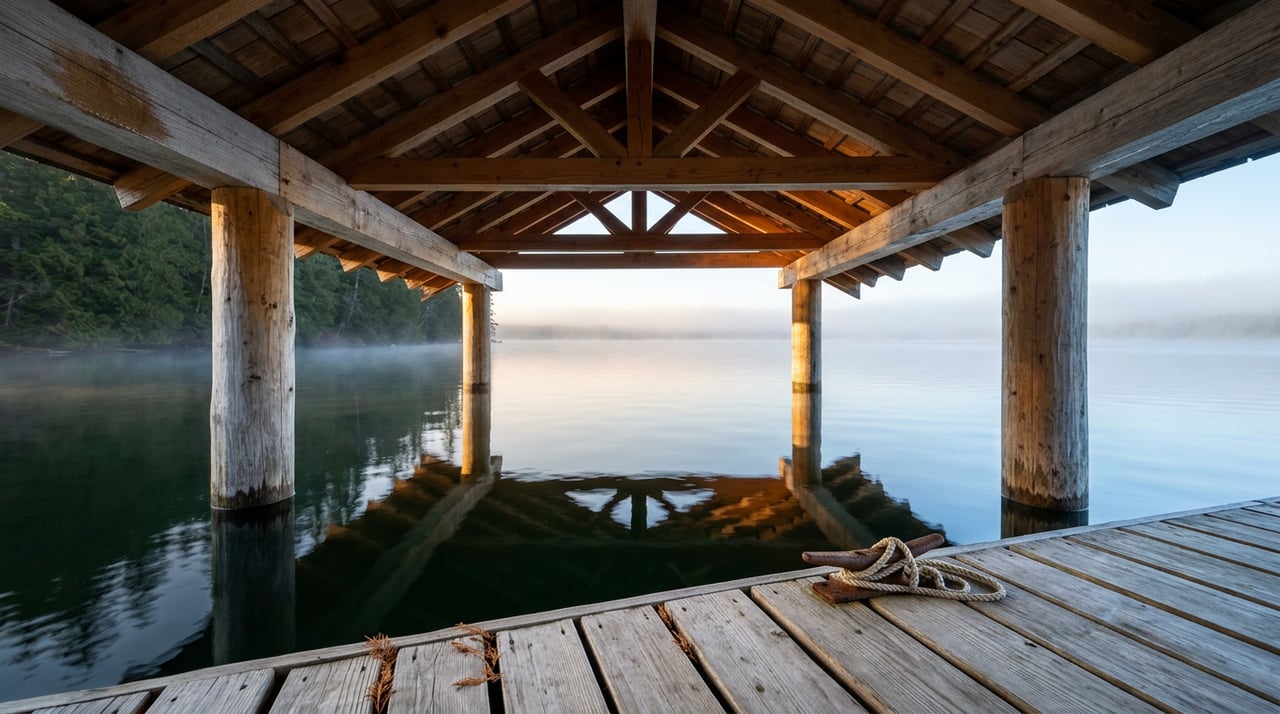
A client toured a Bayview listing with me in July. The lake was at full pool, the dock sat a comfortable two feet above the waterline, and she pictured her grandkids jumping off it every summer. Four months later, after her offer closed and the Army Corps of Engineers ran its annual fall drawdown, that same dock was sitting on exposed mud. Nothing was wrong with the home. Nothing was disclosed incorrectly. She had simply never been told to ask the one question that matters most on Lake Pend Oreille: what does this property look like when the lake isn't full?
That question is the reason I want to talk about Bayview specifically, not North Idaho waterfront in general. Bayview sits on Scenic Bay at the southern end of Lake Pend Oreille, Idaho's largest and deepest lake, and the word "waterfront" gets used there to describe at least three legally and financially distinct products. If you're comparing a Bayview listing to something in Coeur d'Alene or Hayden Lake, the differences aren't cosmetic. They change your financing, your closing costs, and what your dock does in November.
Three Purchases, One Word
Most buyers assume "waterfront" means one thing: you own the land, the land touches the lake, and the water is yours to use whenever you want it. In Bayview, that's true for some properties and not even close for others.
| Fee-simple shoreline | Marina-slip dependent | Floating home | |
|---|---|---|---|
| What you actually own | Land, house, and the shoreline itself | Land and house; dock access is a separate paid arrangement | The structure itself as personal property, moored under a lease |
| How it's financed | Conventional mortgage | Conventional mortgage, but confirm slip terms before closing | Usually a chattel or personal-property loan, often with a higher down payment |
| What the fall drawdown affects | Water depth at your own shoreline, which depends on the underwater grade | Whether your rented slip stays floatable as the lake drops | The home's literal elevation year-round, since it rides the water level by design |
| Governing paperwork | County deed, possibly HOA covenants | Deed plus a separate marina moorage contract | Deed to the structure plus a moorage lease, protected under Idaho's Floating Homes Residency Act |
That third row is the one nobody explains at a showing. All three property types get photographed the same way, from a dock, at full pool, in July. Only one of them keeps that view year-round.
The Dam Nobody Mentions During a Showing
Lake Pend Oreille isn't a natural, static lake. The top eleven and a half feet of it are managed by the Army Corps of Engineers at Albeni Falls Dam, and the schedule is public. Full recreational pool, generally 2,062 to 2,062.5 feet above sea level, is typically held from around late spring through mid-September. Then the drawdown starts.
Last fall, the Corps began the gradual drawdown on September 22 and lowered the lake eleven feet by November 15, holding it near 2,051 feet through the winter to protect kokanee salmon spawning grounds along the shoreline. That's not a one-time event. It's the operating pattern the Lakes Commission describes as having held for more than a decade, tied to an agreement with the Bonneville Power Administration for winter power generation.
What that means on the ground varies enormously by exact location, because Lake Pend Oreille's bottom isn't flat. It plunges to 1,172 feet in places, deep enough that the Navy has run acoustic research there for decades, but shallower coves and gently sloped shoreline lose real depth when eleven feet come out of the lake. A dock in deep water might barely notice the difference. A dock in a shallow cove can end up high and dry until the spring refill, which the Corps generally has stabilized back at full pool by July 4th.
A local advocacy group, the Lake Pend Oreille Alliance, formed in 2014 specifically over concerns like these. Board member Ralph Sletager said at the time that members worried about "the impact to recreation, wildlife, property, scenic beauty and our local economy." The Lakes Commission, a separate state-affiliated group that tracks the dam's operations, has made a related point in its own materials: there's no formal protection if the annual fluctuation damages shoreline structures like docks. That's a real cost that doesn't show up on a listing sheet. If a dock gets stressed by a decade of eleven-foot swings, repair is the owner's responsibility.
Why the Median Price Won't Sit Still
If you've already looked at Bayview's numbers online, you may have noticed they don't agree with each other. As of August 2026, one widely used estimate showed the median list price up 13% year over year, while price per square foot was down 11% over the same period, and down another 3% from the prior month. Those two numbers shouldn't both be true in a market selling comparable homes.
Bayview isn't selling comparable homes. A handful of transactions each month might include a fee-simple lakefront estate, a 350-square-foot floating condo, and a build-ready vacant lot with a water capitalization fee attached, and the "median" blends all three into a single number that describes none of them well. When a market this small and this heterogeneous reports a swing, it usually means the mix of what sold changed, not that values moved uniformly. Anyone using Bayview's median price to gut-check a specific listing is comparing that listing to an average of properties it has nothing in common with.
What Ownership Actually Looks Like Once You're Past the Photo
The paperwork differences compound the physical ones. Vista Bay West, a small lakeside community on Scenic Bay, operates on a cooperative land structure where the land itself is owned collectively by fourteen members, with annual dues around $650 covering water, sewer, trash, and the property taxes on the shared land. That's a fundamentally different ownership model than a standard deed, and it changes how you'd eventually sell or transfer the property.
Gated communities like Cape Horn Estates offer a more familiar structure, shared amenities like a community swim dock, but still require you to understand what the HOA controls versus what you own outright. Meanwhile, vacant shoreline parcels marketed as "no HOA" often carry a one-time water capitalization fee to connect to a community water system, a cost that belongs in your land budget from day one, not a surprise at permitting.
And then there are the floating homes. Scenic Bay is home to roughly half of the roughly 200 historic floating homes left in Idaho, a community with roots back to 1910 fishing shacks. Idaho passed the Floating Homes Residency Act in 1998 specifically to protect these owners from unfair moorage rent increases and evictions, which tells you something about how differently this asset class is treated under the law. It's also treated differently by lenders. Because a floating home is legally personal property rather than real estate, most buyers can't get a conventional mortgage on one. Financing typically comes through a specialty chattel loan, often with a larger down payment and a lender who understands moorage agreements, not a standard 30-year product.
What This Means Before You Write an Offer
None of this means Bayview is a difficult place to buy. It means "waterfront" is doing too much work as a word, and the property type underneath it determines almost everything else about the transaction: how you finance it, what maintenance falls to you, and whether the view you toured in July is the view you'll have in November.
Before you get attached to a listing, ask what kind of waterfront it actually is. Ask whether the dock or moorage is deeded to the property or leased separately. If it's a floating home, ask your lender early, not after you're under contract, since chattel financing takes different underwriting than a conventional loan. And if you can, ask to see or ask about the property's condition after a fall drawdown, not only during a summer showing.
Common Questions From Out-of-State Buyers
Can I get a normal 30-year mortgage on a Bayview floating home? Usually not. Most lenders treat floating homes as personal property rather than real estate, so financing typically runs through a chattel or personal-property loan, often requiring a larger down payment than a conventional mortgage.
Does every waterfront listing in Bayview come with deeded lake access? No. Some properties include the shoreline itself in the deed. Others rely on a separate paid slip at a marina or a shared community dock. Confirm which one you're looking at before you assume year-round access.
Is it true the lake drops every winter? Yes. The Army Corps manages roughly the top eleven and a half feet of Lake Pend Oreille, holding full recreational pool through summer and drawing it down to protect kokanee spawning grounds each fall, typically reaching winter elevation by mid-November and refilling by early summer.
What is Vista Bay West's ownership structure? It's a small cooperative community on Scenic Bay where the land is owned collectively among the members rather than through individual fee-simple lots, with annual dues covering shared services.
If you're weighing a Bayview property against something in Hayden, Coeur d'Alene, or Sandpoint, the comparison only works once you know which kind of waterfront you're actually pricing. I'd rather walk that through with you before you fall for a photo than after you've written an offer. Rachael Holzhauser offers a free consultation for exactly this kind of question, and it's worth the conversation before you tour your next listing on the lake.